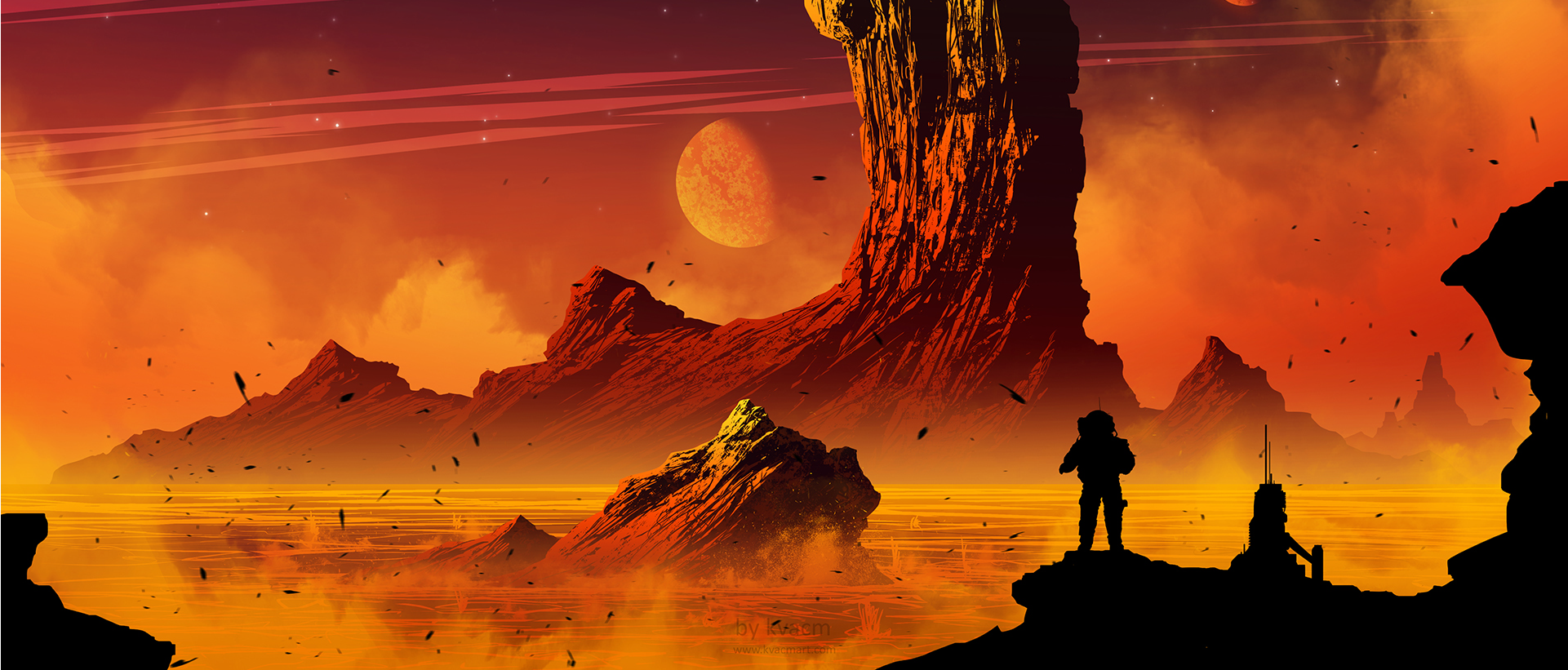
With six voyages to choose from, Helios Space Expeditions is sure to provide you an unforgettable experience at any of the planets. We have included information about each planet’s climate, activities, and amenities, so you can choose whichever destination best suits your interests. Happy traveling!

This package will take advantage of a rare alignment of the outer planets to allow passengers to explore them all in quick succession—from Jupiter to Neptune, tourists can experience the charm of gravity assists.

Frigid and alien, yet similar to our own planet billions of years ago, Saturn's largest moon, Titan, has a thick atmosphere, organic-rich chemistry and a surface shaped by rivers and lakes of liquid ethane and methane. Cold winds sculpt vast regions of hydrocarbon-rich dunes. There may even be cryovolcanoes of cold liquid water.

The discovery of Enceladus' icy jets and their role in creating Saturn's E-ring is one of the top findings of the Cassini mission to Saturn. Further Cassini mission discoveries revealed strong evidence of a global ocean and the first signs of potential hydrothermal activity beyond Earth – making this tiny Saturnian moon one of the leading locations in the search for possible life beyond Earth.

Mars is a destination made for thrillseekers. Perfect for climbing, hiking, and exploring. Rent a dirt bike or ATV and race across the rocky terrain, fly across the canyons on ziplines, and hike to the peak of one of the many mountains. Dedicated, experienced tour guides are here to help you with your adventures. For the brave and seasoned, a 22 kilometer hike to the top of Mount Olympus is a once in a lightyear experience.

The Jovian cloudscape boasts the most spectacular light show in the solar system, with northern and southern lights to dazzle even the most jaded space traveler. Jupiter's auroras are hundreds of times more powerful than Earth's, and they form a glowing ring around each pole that's bigger than our home planet. Revolving outside this auroral oval are the glowing, electric “footprints” of Jupiter's three largest moons.

Like Luke Skywalker's planet "Tatooine" in Star Wars, Kepler-16b orbits a pair of stars. Depicted here as a terrestrial planet, Kepler-16b might also be a gas giant like Saturn. Prospects for life on this unusual world aren't good, as it has a temperature similar to that of dry ice. But the discovery indicates that the movie's iconic double-sunset is anything but science fiction.